Lingkar Pintar machines sell drinks, snacks and fresh food in offices and on campuses. Pay with QRIS from any e-wallet or mobile banking app. Come back often and your circle rewards you.
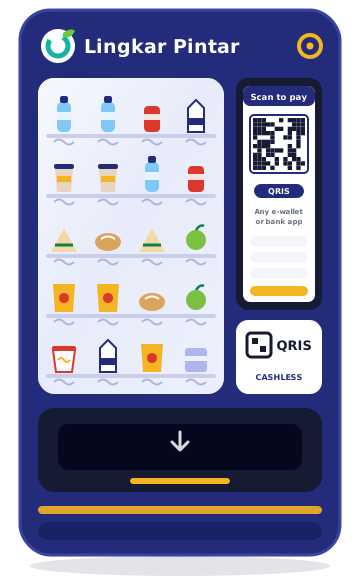
Lingkar Pintar is more than a vending machine. It is three things that work together, so every machine becomes a small shop people come back to.

A mixed menu, not just soft drinks: what people actually want at work or on campus, from morning coffee to an evening meal.
Scan the code on the screen with any e-wallet or mobile banking app. The price you see is the price you pay.
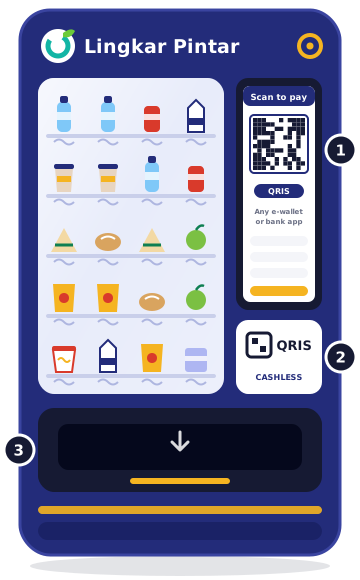
One dynamic QR code per order. Pay with GoPay, OVO, DANA, ShopeePay or your bank's mobile app, and your receipt stays in that app.
Each code is valid for a short time. If it expires before you pay, the order is cancelled. Choose again and the screen shows a new code.
Every machine has its own circle: the people who buy there every day. The Circle turns a quick purchase into a habit, and a habit into a small community on every floor and campus.

No app needed to join. Your phone number is enough to collect stamps at the machine. The app adds live stock, vouchers and your whole circle in one place.
For a building, the Circle means a pantry people actually talk about. For us, it means regulars instead of one-off buyers.
Every buyer sees their stamp card, even without the app. A phone number saves it; a full card earns a free coffee.
Stamp card first, the nearest machines with live stock, and one deal for today. Opens straight from the QR on any machine.
Example screens with sample data.
We bring, run and care for every machine. Our partners get a pantry close by, income from their space, and a Circle of people who come back to their building.
Host a machine in your lobby, canteen or library.
Reach office workers and students where they buy every day.
Local kitchens and bakeries supply fresh items daily.
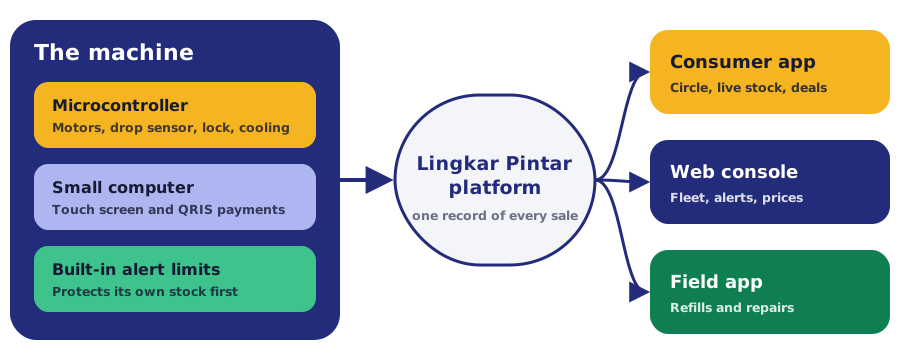
Every machine runs on our own hardware and software. That's why it can do these four things for you.
Offices, campuses, brands and suppliers: let's start with a site visit.
We place, stock, run and repair smart vending machines. You choose how to take part: host a machine, reach buyers with your brand, or supply the fresh food inside. This page shows what you get, what it costs you and how to start.
Buildings compete for tenants, brands look for new places to meet buyers, and a young workforce expects food close by. Lingkar Pintar sits where all three meet.
In Q1 2026, with no new office buildings completed that quarter.
Source: CBRE, Q1 2026Their share of Indonesia's 284.67 million people in 2025.
Source: BPS via Databoks, 2026Projected for 2025, growing 17.8%.
Source: GroupM via Campaign IndonesiaIndonesia's largest advertising category in the first half of 2025.
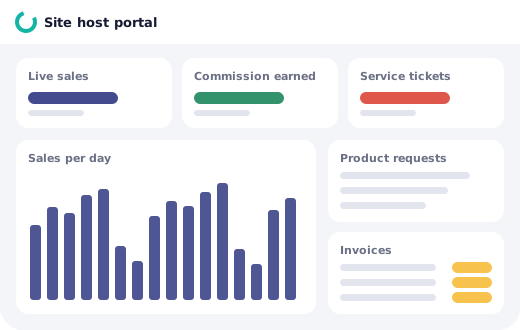
Source: Nielsen, 2025You give us a spot people pass every day. We do everything else, and you see every sale and every service visit in your own portal.
Sketch of the site host portal.
Site visit. We check these details with you during the site visit, before we propose a contract model.
Every machine sits under a contract. We recommend a model after the site visit.
| Model | How it works |
|---|---|
| Revenue share | A percentage of net sales, which can rise with volume. |
| Fixed rent | A monthly fee per machine. |
| Hybrid | A minimum guarantee, plus a share of sales above an agreed level. |
| Free placement | You get the service, with no payments either way. Suited to small sites. |
| Subsidised pantry Employee benefit | You pay part or all of the price for your employees, invoiced monthly. |
| Machine rental or purchase | You rent or own the machine, and Lingkar Pintar runs it as a service. |
| Brand sponsored | A brand pays for placement or branding and gets its own slots or screen time. |
Contracts are available in Bahasa Indonesia and English.
Office workers and students stand in front of our screen every day, ready to choose. Pick one way to work with us or combine them, and follow the results in your brand partner portal.
Your own slots in chosen machines, or a fully brand-sponsored machine.
Your content in the idle loop on the machine's 22-inch screen.
Buyers get a free trial size after scanning, and you get a lead with their consent.
You fund a discount or voucher for your product, and see how it performs.
Put a new product in the trial slot and let the Circle vote on it.
What you see, and what you don't. Your brand partner portal shows campaign performance, how your slots perform and insights about your audience. Brands see aggregated, anonymous results. Personal data stays with Lingkar Pintar and is only used with consent, in line with Indonesia's personal data protection law (UU PDP).
Local kitchens, bakeries and producers supply the fresh food and local favourites inside every machine. We order from real sales, not guesses, and sell items close to their date before they go to waste.
Every partnership follows the same steps. We agree the timing with you.
What partners usually ask before they sign.
With QRIS only. Lingkar Pintar is cashless: buyers scan the code on the screen with any e-wallet or mobile banking app, such as GoPay, OVO, DANA or ShopeePay.
It depends on the contract model. In free placement there are no payments either way; in the subsidised pantry model you pay part or all of the price for your employees, invoiced monthly. Who pays for electricity is set in the contract.
We do. Our team stocks, cleans and repairs every machine, and the machine reports its own faults so a technician knows what to fix. If a product doesn't drop, the buyer's payment is refunded automatically.
Yes. You can request products in your portal and set product rules in the contract, such as halal only. Every machine also keeps one slot for trying something new.
Every product shows its halal status on the screen and in the app. From 18 October 2026, food and drink from micro and small businesses must be halal certified, and we store the halal certificate number and expiry date for every product.
Start and end dates, renewal and the notice period are set in each contract.
Every month you get an automatic statement of sales and commission, and your invoices are in your portal.
Sales per machine and, only for Circle members who agree, their stamps and preferences. Hosts and brands see aggregated, anonymous results, and members can ask us to delete their data, in line with UU PDP.
Tell us about your building, your brand or your kitchen, and we'll come back with a proposal.
Lingkar Pintar combines its own smart machines with an engagement layer that turns buyers into regulars. The pilot starts with 5 to 10 machines in office towers and campuses.
QRIS is how Indonesians pay every day, and the vending market keeps growing. The gap is an operator that runs a mixed fleet well and gives people a reason to come back.
In November 2025. Any e-wallet or mobile banking app pays at our machine.
Source: Bank Indonesia via IDX ChannelFrom USD 435.2 million in 2024, growing 9.90% a year from 2025 to 2030.
Source: Next Move Strategy ConsultingThe Bank Indonesia rate for regular merchants, per successful transaction.
Source: MidtransProjected for 2025, growing 17.8%. Brands pay to reach buyers where they buy.
Source: GroupM via Campaign IndonesiaWhere we win. Running machines well is necessary, but it is not enough. Lingkar Pintar competes on the Circle, which turns buyers into regulars; on mixed goods with fresh food and shelf-life control; and on trust at every machine: an automatic refund plus a voucher when a product fails to drop, and live stock in the app before you walk over.
Product sales carry the business from day one. Brand partnerships on the screen and in the Circle add more revenue lines on the same platform.
We prove the unit economics on 5 to 10 pilot machines before building the full engagement layer. Each phase must pay for the next.
Exit criterion: a positive machine P&L on at least half of the pilot machines.
Instead of buying separate telemetry, payment and loyalty tools, we build our own microcontroller board and run our own software, so the machine, the data and the Circle all belong to one platform.
Every purchase teaches the system something. It uses that to give the right person the right reason to come back, within a budget.
Sales on the machine feed the console. The console sends routes, prices and repair tickets out. The field team keeps the machine selling. Then it starts again.
How the fleet actually runs, for investors only. Four flows cover the whole loop; all data on the screens is illustrative.
The consumer flow at the machine. Every screen has one main action in yellow and a way back. Scroll sideways through the steps.
Plays when nobody is using the screen. Rotates offers, brand content and paid ads.
Ranked per session: deals and best sellers here now, then the rest. Bundles apply by themselves in the cart.
Optional step: opens on a long tap or the info icon. Most customers go straight from menu to pay.
Dynamic QRIS with the exact amount and order ID. The ring shows the time left; when it runs out, the order cancels cleanly.
The vend controller drives the spiral, the IR curtain confirms each drop, then the next item starts.
Confirms the payment and where the receipt went, then hands the screen back to the next customer.
Cooling fails on machine LP-0142 in a Kuningan office lobby. The customer is protected first, the system reacts by itself, and the technician arrives knowing the cause.
States exactly what failed, what was refunded, to where and how fast. The voucher turns a bad moment into a reason to return.
Opens with a staff NFC card and shows only what's needed to fix this machine: the open ticket, each fault with the test that proves it's fixed, and what must be done before leaving. Stock, sales and full machine status stay in Fleet Management.
One inbox for every machine problem, sorted by severity and time. Alert thresholds are built into the microcontroller, so the console only receives the alert, the evidence and what the machine already did by itself. The inbox shows who is on it and when it escalates.
Everything about one machine on one screen. The slot grid mirrors the physical machine, so what the console shows is what the driver sees when the door opens. Chilled rows are hatched because the machine disabled them itself; D2 is outlined red for a jam, the same chocolate cheese bun that failed on the kiosk. The temperature chart and compressor current point at the cause before anyone drives there.
The biggest cost in vending is the visit. The route team only visits machines that need it, brings exactly what they need, and removes what is about to expire.
| Machine | Location | Status | Stock | Expiring < 48 h | Today |
|---|---|---|---|---|---|
| LP-0142 | Tower A Lobby | Error | 62% | 2 units | Rp 1.842.000 |
| LP-0107 | Setiabudi Campus | Needs refill | 18% | 0 units | Rp 1.315.500 |
| LP-0133 | Mampang Campus | Online | 81% | 4 units | Rp 1.108.000 |
| LP-0121 | Kuningan Tower | Offline | 55% | 1 unit | Rp 642.000 |
Pick list per slot straight from the crate, expired units to remove, and open tickets merged into the same route so nobody drives out twice.
Any change pushed to machines shows its difference first and rolls out in waves with an automatic stop. Performance then shows which machines earn their place.
| Product | Old | New | Difference | New margin |
|---|---|---|---|---|
| Iced palm sugar latte | Rp 18.000 | Rp 19.000 | +5,6% | 41% |
| Iced jasmine tea | Rp 7.500 | Rp 7.500 | same | 38% |
| Mineral water 600 ml | Rp 5.000 | Rp 4.500 | −10% | 29% |
| Chocolate milk 250 ml | Rp 9.900 | Rp 9.900 | same | 33% |
One wizard for anything pushed to machines: prices, planograms, screen content, software. It always shows the difference before sending, and rolls out in waves with an automatic stop, so a mistake reaches a few machines instead of the whole fleet.
| Machine | Site type | Revenue per day | Margin | Uptime | Suggestion |
|---|
Answers the question the business asks most: which machines earn their place. Ranked by gross profit per day, not revenue, with a concrete suggestion per machine: keep, add capacity, change the mix, or move. The heatmap shows when the fleet sells, which drives dayparting and route timing.
Variations of the kiosk screens above, each with agreed copy and behavior before the build.
| State | What the customer sees | What the machine does |
|---|---|---|
| Cooling failure | Chilled products are greyed out as temporarily unavailable. | Disables chilled slots, blocks affected batches and opens a ticket. |
| QR expired | A message that the QR code expired, with a prompt to pick again for a new code. | Cancels the order with the payment provider and returns to the menu with the cart kept. |
| Payment late | "Checking payment" with a spinner ring, for a short time. | Polls the provider; if the payment arrives after cancelling, it vends or refunds automatically. |
| Machine empty | The idle screen shows the nearest machine with stock and the walking time. | Stops taking orders and raises a must-visit for the route team. |
| Accessibility mode | Large text, all buttons in the lower half, audio feedback on. | Switched on by a fixed button at wheelchair height. |
| Language | All text switches between English and Bahasa Indonesia; prices stay in rupiah. | Remembers the choice for the session. |
Each phase must pay for the next. The pilot runs in office towers and campuses.
Microcontroller, small computer, kiosk screens, dynamic QRIS, drop sensor, automatic refunds, event logging.
Exit: 500 vends without a stuck payment or lost product.
Fleet console, alerts inbox, stock per slot, field app with pick lists, simple forecast, contracts and commissions.
Exit: positive machine P&L on at least half the machines.
Stamps, vouchers, refer a friend, menu voting, machine suggestions, consumer app and PWA.
Exit: a measurable rise in repeat rate against the pilot baseline.
Route and assortment optimisation, markdowns, brand slots, screen media and a brand portal. Games and photobooth come later.
Exit: cost per visit and spoilage down, new revenue lines live.
From 18 October 2026, food and drink from micro and small businesses must be halal certified. Legal counsel confirms each point before launch.
| Area | What applies | What the product does |
|---|---|---|
| Halal | From 18 October 2026, food and drink from micro and small businesses must be halal certified; medium and large businesses since 17 October 2024; imported products by 17 October 2026. Source: BPJPH | The product list stores the halal certificate number and expiry date per product. Kiosk and app show the halal status of every product. |
| Personal data | UU PDP 27/2022, fully in force since 17 October 2024. | Consent per purpose (marketing, location, Circle profile), privacy notice on kiosk and app, deletion on request. No biometric data collected. |
| Payments | QRIS through a licensed payment provider. The Bank Indonesia fee for regular merchants is 0.7% per successful transaction. Source: Midtrans | Cashless: QRIS only. One dynamic QRIS code per order; the price on screen is the price charged; the provider's settlement report, our ledger and the machine's vend log are reconciled every day. No stored-value wallet is planned. |
| Food safety | Temperature logging for chilled goods; BPOM registration per product. | The cooling threshold in the machine blocks affected batches automatically; temperature log kept per zone. |
| Prize promotions | Rules on prize draws and consumer protection (UU 8/1999), relevant when games launch. | Every game gives a guaranteed prize, so no draw rules apply; confirm with counsel. |
| Platform and devices | PSE registration with Komdigi; SDPPI certification for our own boards with a radio; OSS business licence. | Register and certify before public launch. |
One visual language for all four interfaces: the kiosk, the consumer app, the field app and the web console. Everything in it grows from one idea: every machine is a point on the ring.
Every screen decision is checked against these four rules.
Colors are named after Indonesian materials so the team can talk about them easily. Each has one job; mixing jobs is what makes interfaces confusing.
Plus Jakarta Sans, an open-source family made for Jakarta's city identity. Weights 400 to 800, with tabular figures so prices line up.
A 4 px grid, doubled on the kiosk. The rounder an element, the more it is about a person or an action; the squarer, the more it is about data.
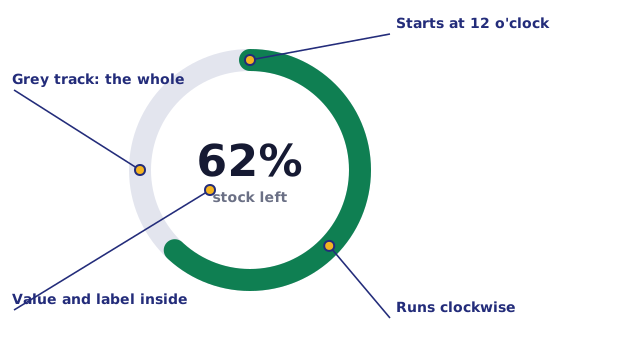
The signature element, taken from the logo. One component does four jobs across the product, always read the same way.
The same building blocks appear on every interface, adjusted only in size.
Kunyit for the customer's one action, Nila for staff actions, outline for the way back, red outline only for destructive staff actions.
Always color plus a word, never color alone.
The same tokens and components, sized for where and how each interface is used.
| Interface | Who | Canvas | Body text | Touch target | Character |
|---|---|---|---|---|---|
| Kiosk | Consumer, Technician | 1080 × 1920 portrait | 28 px | 88 px | Big, bright, one action per screen |
| Consumer app | Consumer | 360–430 px | 16 px | 48 px | Friendly, stamp ring first |
| Field app | Technician, Staff Fleet | 360–430 px | 17 px | 56 px | One-handed, readable in sunlight |
| Web console | Staff Fleet | 1280 px and wider | 14 px | Dense tables | Calm, indigo and grey |
Say what happened and what happens next, with exact numbers.